

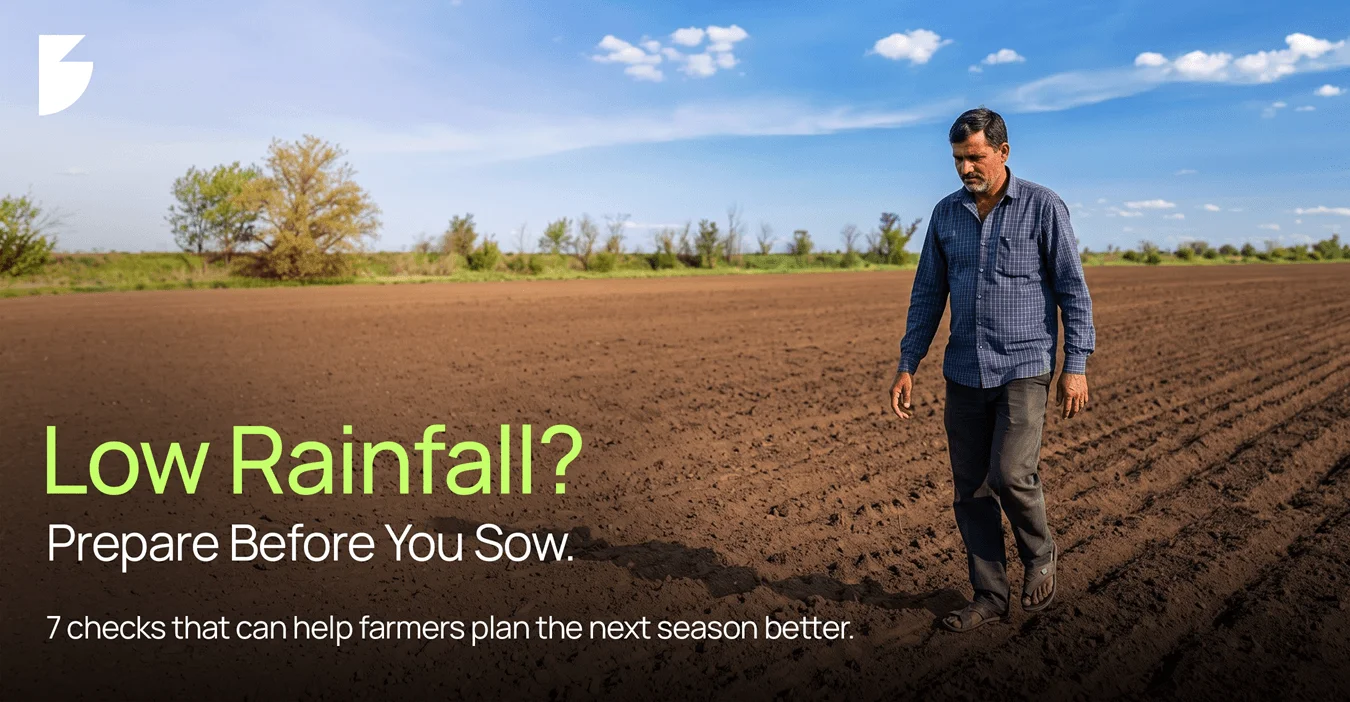
Low rainfall does not only affect the current crop. It can also influence water availability for the next sowing season.
When rainfall is below expectations, farmers may enter the next season with lower water availability in wells, borewells, farm ponds and other sources. In such conditions, starting sowing without understanding available water can increase risk later in the crop cycle.
The better approach is simple: plan water before planning the crop.
Here are seven practical checks farmers should make before the next sowing season.
1. Check How Much Water Is Actually Available
Before deciding what or how much to sow, assess your available water sources.
Check your borewell, well, farm pond or other irrigation source. The important question is not simply “Do I have water?” but:
“Is this water enough to support the crop through its required irrigation period?”
This gives you a more realistic starting point for farm planning.
2. Plan the Sowing Area According to Water Availability
More cultivated area does not always mean better returns when water is limited.
If available irrigation water cannot reliably support the entire farm, farmers should carefully plan the area under cultivation rather than creating water stress across a larger area later.
Available water and planned acreage should be considered together.
3. Understand the Crop’s Water Requirement
Different crops – and different growth stages – have different water requirements.
Before selecting the next crop, understand its expected irrigation needs and whether your available water resources can realistically support them.
Crop selection should therefore consider not only market opportunity, but also local conditions and water availability.
4. Check Your Irrigation System Before Sowing
Don’t wait until the crop needs water to discover an irrigation problem.
Before sowing, inspect your drip irrigation system, including:
- Filters
- Pressure
- Drippers
- Pipes and joints
- Valves
- Water delivery at the end of irrigation lines
A small blockage, leakage or pressure problem can reduce irrigation efficiency when every drop matters.
5. Look for Areas Where Water Is Being Wasted
Water loss is not always obvious.
Leakages, damaged pipes, unnecessary runoff, blocked drippers or poorly managed irrigation can all affect how efficiently available water reaches the crop.
A simple farm irrigation check before the season can help identify avoidable losses early.
6. Consider Water-Saving Farming Solutions
When water availability is uncertain, technologies such as drip irrigation, irrigation automation and mulching can become part of a broader water-management strategy.
The objective should not simply be to irrigate more.
It should be to use available resources more precisely and efficiently.
7. Make the Water Plan Before the Sowing Plan
Sowing is the beginning of a crop, but planning needs to begin much earlier.
Before the next season, farmers should understand three things:
How much water is available?
How much water will the crop require?
How much area can be managed with it?
When these answers are clear, better farming decisions can follow.
Prepare Today for the Next Season
Rainfall cannot be controlled. Preparation can.
With uncertain rainfall patterns and increasing pressure on agricultural water resources, efficient irrigation and better water planning are becoming increasingly important for Indian farmers.
Bhumi helps farmers adopt smart irrigation, drip irrigation, automation, mulching and other farm solutions designed to improve control and resource efficiency.
Plan before you sow. Connect with Bhumi for smarter farming solutions.