

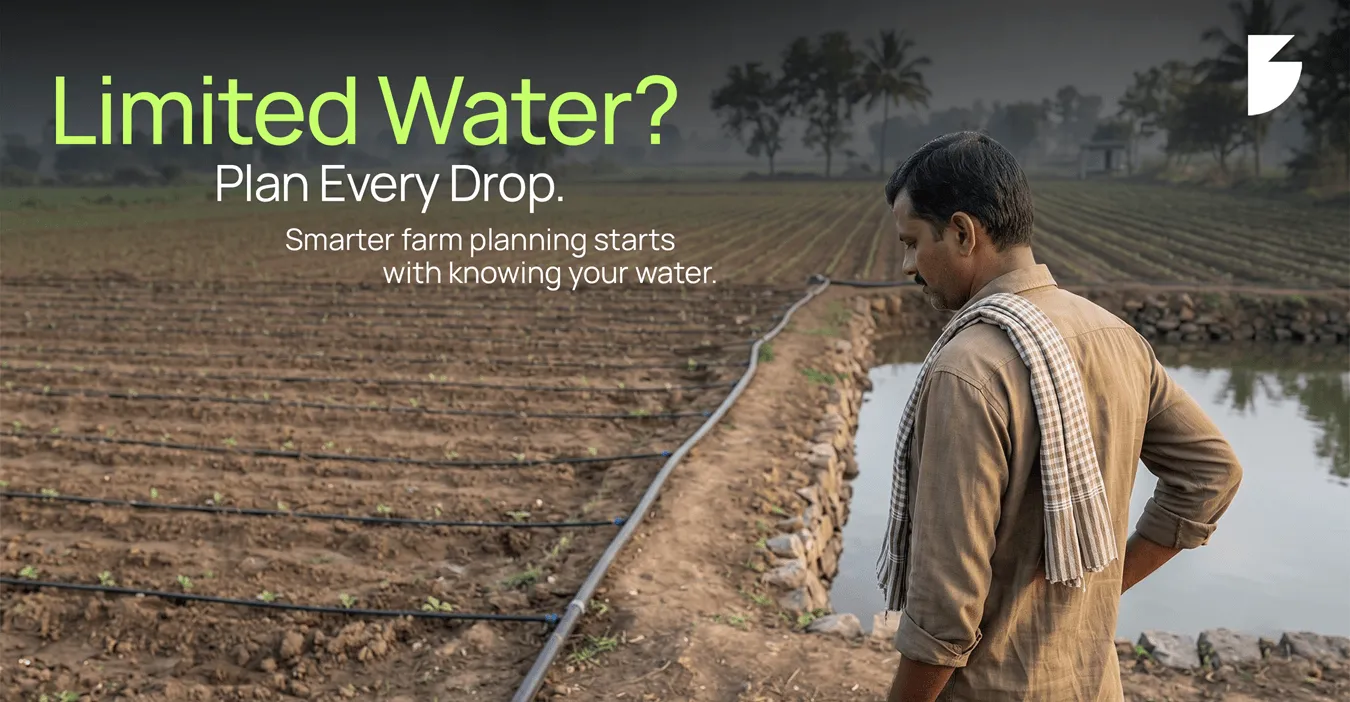
Limited water changes the way a farm needs to be planned.
The instinct may be to focus first on the crop, acreage or sowing date. But when irrigation water is limited, there is an even more important question to answer:
How much farming can the available water reliably support?
Effective water management in agriculture begins before irrigation starts. It begins with planning.
Here is a practical approach farmers can use when water availability is limited.
Start With a Water Budget
Think of available water like any other limited farm resource.
Identify your available irrigation sources – such as borewells, wells, farm ponds or stored water – and assess their current condition and availability.
This creates a basic farm water budget.
Instead of deciding the cultivation area first and worrying about water later, reverse the process:
Available Water → Crop Requirement → Cultivation Area
This simple change in thinking can help farmers make more informed decisions before sowing.
Match the Crop With Available Water
Crop planning should consider local conditions, soil, season, market potential and water requirements.
When water is limited, understanding how much irrigation the selected crop may require becomes especially important.
A crop that cannot be adequately supported by available water may create greater risk as the season progresses.
For crop-specific decisions, farmers should follow appropriate local agronomic recommendations.
Don’t Spread Limited Water Too Thin
Suppose the available water can reliably support only part of the planned cultivation area.
Trying to irrigate a much larger area with the same resource can potentially leave the entire crop under water stress.
This is why irrigation planning and acreage planning need to happen together.
The goal is not simply maximum area.
The goal is better use of the area and resources available.
Make Every Drop Reach the Crop
Having a drip irrigation system is not enough if it is not performing correctly.
Before and during the season, check:
Is the filter clean?
Is pressure adequate?
Are drippers blocked?
Are pipes or joints leaking?
Is water reaching the last plant?
Regular checks help identify problems that could otherwise waste valuable irrigation water.
Use Irrigation More Precisely
Drip irrigation helps deliver water closer to the crop root zone, while irrigation automation can help farmers improve control over when and where irrigation takes place.
Mulching can also form part of a farm’s water-management approach by helping manage soil moisture and reducing unnecessary water loss from the soil surface.
The right solution, however, depends on the farm, crop and local conditions.
Monitor, Don’t Assume
A water plan made before sowing should not remain unchanged for the entire season.
Farmers need to continue observing crop conditions, available water and irrigation-system performance.
If the situation changes, the plan may need to change too.
That is what makes smart farming different from simply installing technology—it combines better systems with better decisions.
Limited Water Needs Better Control
When water is abundant, inefficiency can sometimes go unnoticed.
When water is limited, every unnecessary loss matters.
The future of efficient farming therefore isn’t simply about finding more water. It is also about managing available water better.
At Bhumi, we work towards helping farmers gain greater control through drip irrigation, smart irrigation systems, automation, mulching and integrated farming solutions.
Because when water is limited, every drop should have a purpose.
Connect with Bhumi to plan smarter irrigation for your farm.