

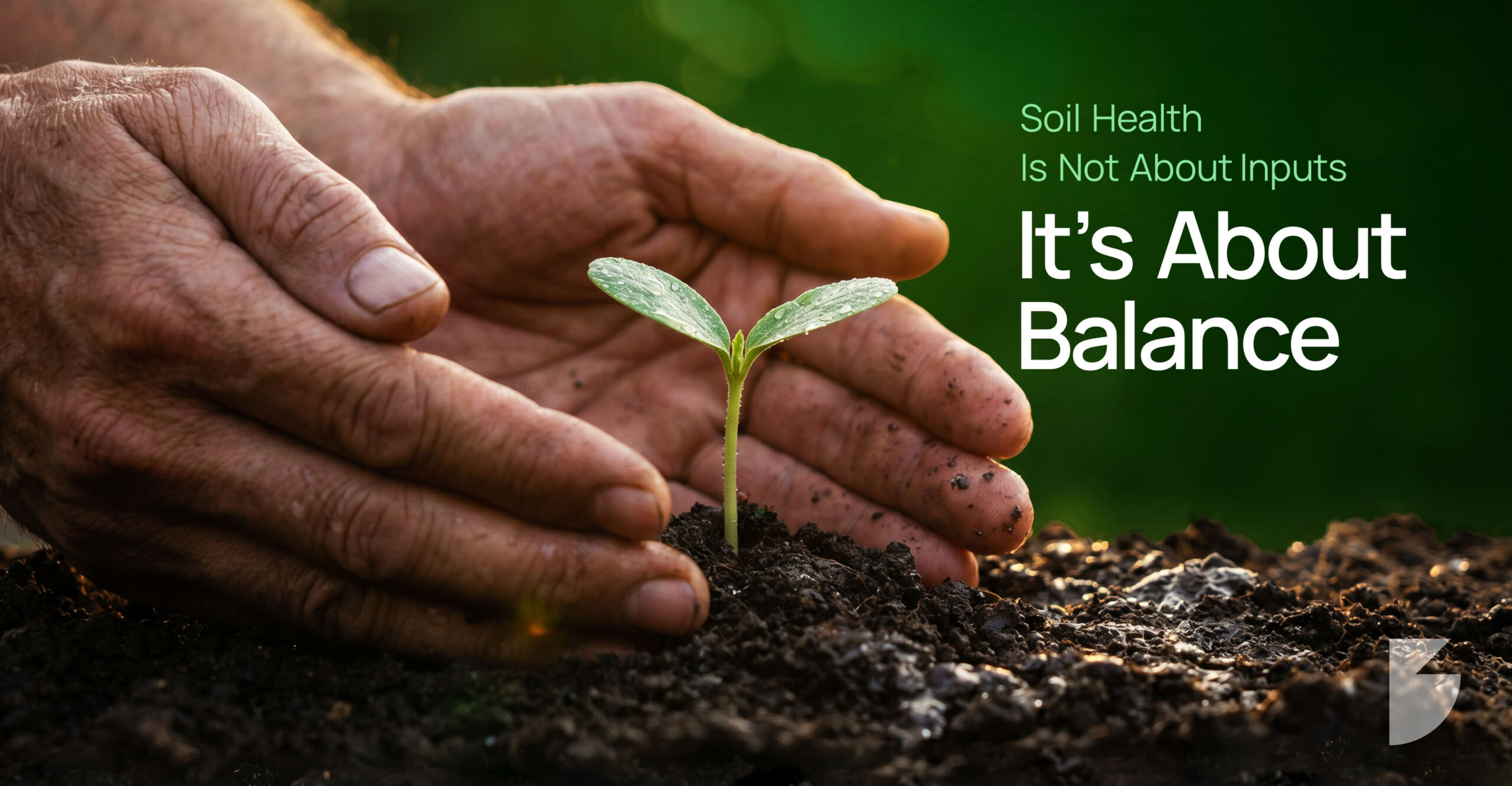
For a long time, improving soil felt simple. If crops didn’t perform well, the answer was to add more — more fertilizer, more inputs, more effort. And for a while, it worked.
But over time, the same soil starts demanding more while giving less. Water doesn’t hold the same way, fertilizers don’t respond as expected, and results become inconsistent.
At that point, the question usually is: “What else should we add?”
But the real issue is often not a shortage — it’s an imbalance.
Soil is a Living System
Soil is not just a surface; it is a living system. Beneath it, microorganisms break down organic matter, nutrients are cycled, and roots interact with this environment.
A healthy soil depends on balance between:
- Organic matter
- Microbial activity
- Moisture
- Nutrient availability
When this balance is maintained, soil performs naturally.
What Goes Wrong
When the system is disturbed:
- Nutrients are not used efficiently
- Soil structure weakens
- Water retention reduces
- Dependence on inputs increases
Adding more may help temporarily, but it doesn’t fix the root problem.
A Better Way to Think
The shift is simple:
From asking — “What should I add?”
To asking — “What is out of balance?”
Focusing on balance means:
- Maintaining organic matter
- Supporting soil biology
- Managing water properly
- Avoiding excess inputs
Final Thought
Healthy soil doesn’t make noise, but it defines outcomes.
When the balance is right, crops grow better, inputs work efficiently, and farming becomes more stable.
At Bhumi, we believe better farming starts with understanding the system beneath the surface — because when balance is right, results follow naturally.