

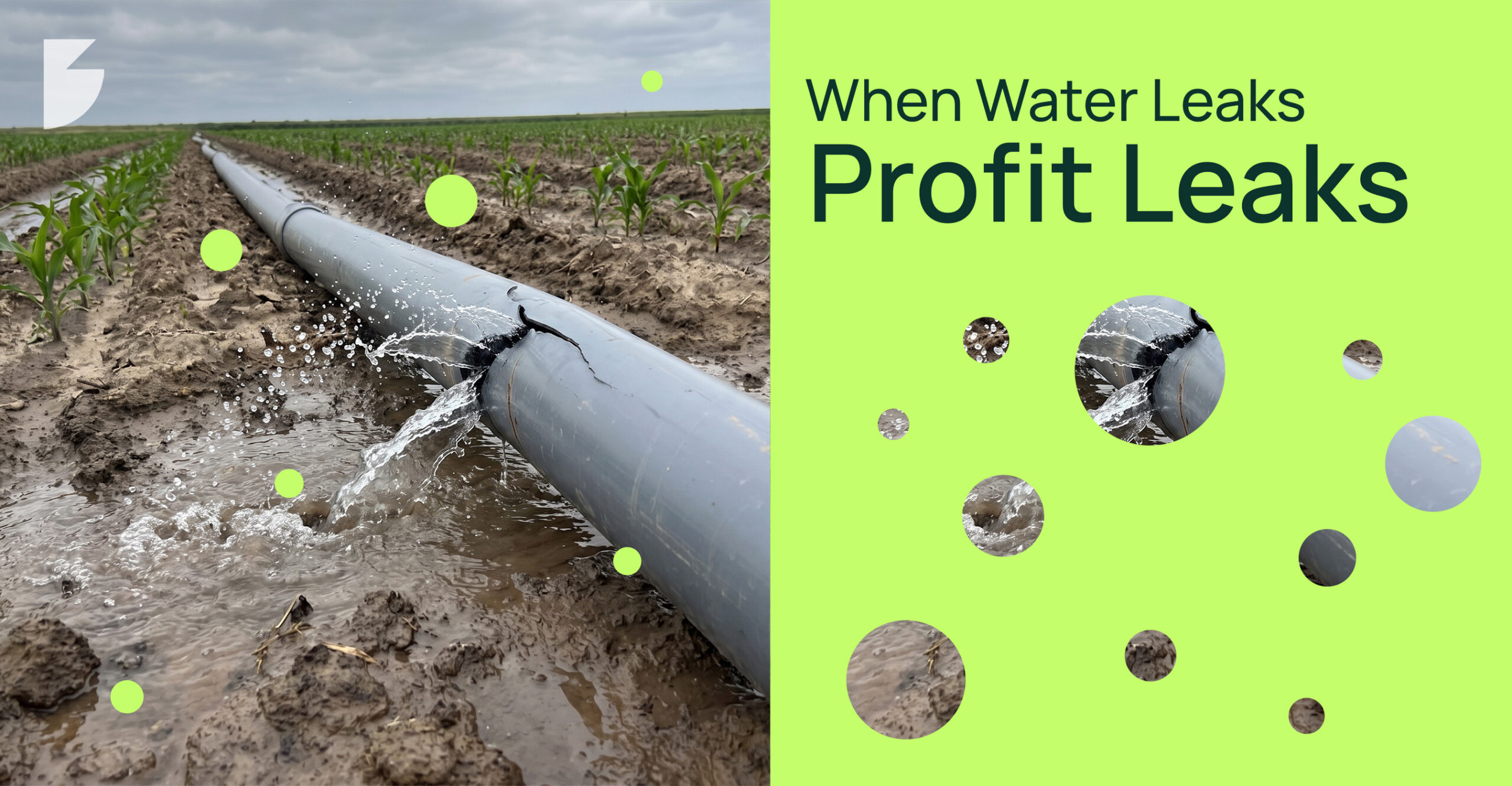
A pipe leak may look like a small maintenance issue.
A wet patch near a joint.
A slow drip from a damaged line.
A small crack that seems easy to ignore.
But in farming, even a minor leak can create losses that go far beyond the water escaping from the pipe.
It can reduce pressure, affect irrigation uniformity, increase pumping time, waste energy, disturb fertigation and create additional labour costs.
The real concern is that most of these losses are hidden.
Water Loss Is Only the First Loss
When water leaks from a pipeline, it does not always reach the part of the field where it is needed.
This may lead to uneven water distribution. One area may receive too little water, while another may receive more than required.
Over time, this can affect crop consistency.
Some plants may grow well. Others may show stress. Some areas may require repeated attention. The result is a field where crop performance becomes uneven—not because of one major mistake, but because of small water losses happening continuously.
Pressure Loss Can Affect the Entire Irrigation System
Water pressure is one of the most important factors in irrigation performance.
When a pipeline leaks, pressure can drop. This affects how efficiently water travels through the system.
In drip irrigation, pressure loss can be especially important because emitters depend on proper pressure to distribute water consistently. If pressure becomes uneven, plants located farther from the source may receive less water than those closer to it.
The issue may not be obvious in a single day.
But across a season, uneven irrigation can affect root development, crop growth and overall field performance.
Leakage Can Increase Energy and Pumping Cost
A leaking system may require the pump to run longer to deliver the required amount of water.
That means more electricity or fuel use.
For a farmer, this can become a recurring cost—especially when a small leak is ignored over several irrigation cycles.
The system works harder, but the crop may not receive the full benefit.
This is why leakage is not only a water issue. It is also an energy-efficiency issue.
Fertigation Loss Can Be Even More Expensive
In systems where fertilizer is supplied through irrigation, pipe leakage can create an additional problem.
Water and nutrients may escape before they reach the intended root zone. This means part of the fertilizer investment may be lost outside the crop area.
The impact is not limited to cost.
Uneven nutrient delivery can also create uneven crop response. Some plants may get the right nutrition, while others may not receive enough.
When water flow is not controlled, fertilizer efficiency is also affected.
Soil Damage and Waterlogging Risk
Continuous leakage near one area can create excess moisture around the damaged point.
This can lead to wet patches, soil erosion or even waterlogging in certain conditions. If water stays in one place for too long, soil structure and root health may also be affected.
So while one part of the field may suffer from low water pressure, another may suffer from excess water.
That is the hidden imbalance leakage can create.
Signs That Should Not Be Ignored
Farmers should inspect pipelines regularly and watch for signs such as:
- Wet soil patches where they should not be
- Visible leakage near joints or fittings
- Lower pressure in the system
- Uneven water flow across the field
- Longer pumping time than usual
- Repeated repairs at the same point
- Crop rows showing different growth patterns
The earlier a leak is detected, the easier and less expensive it is to manage.
How to Reduce Leakage Risk
Good irrigation performance begins with the right pipe, proper installation and timely maintenance.
A few practical steps can help:
Choose Quality Pipes and Fittings
A strong system starts with durable materials suited to farm conditions.
Ensure Proper Installation
Incorrect jointing, poor alignment or inadequate support can create problems later.
Check Pressure Regularly
Unexpected pressure changes can indicate leakage or blockage.
Inspect Before Every Major Season
Monsoon, sowing and peak irrigation periods are the right time to inspect the entire line.
Repair Early
Small leaks are easier to fix. Delayed repairs often lead to larger replacement costs.
Every Drop Matters
In farming, water is not just water.
It is energy.
It is labour.
It is fertilizer efficiency.
It is crop growth.
And ultimately, it is farm profitability.
That is why leakage should never be treated as a small issue.
At Bhumi Irrigation, we believe water must reach the right place—without loss, pressure drop or uncertainty.
Because when water flows right, the farm performs better.
For reliable pipes, fittings and irrigation solutions, connect with Bhumi Irrigation.