

For a long time, farming has focused on one simple question:
How much fertilizer should the crop receive?
But future farming will ask a deeper one:
How healthy is the soil that receives it?
Chemicals and fertilizers will continue to play an important role in agriculture. But they cannot work at their best when the soil is weak, compacted, low in organic matter, or biologically inactive.
Because soil is not just a growing medium.
It is a living system.
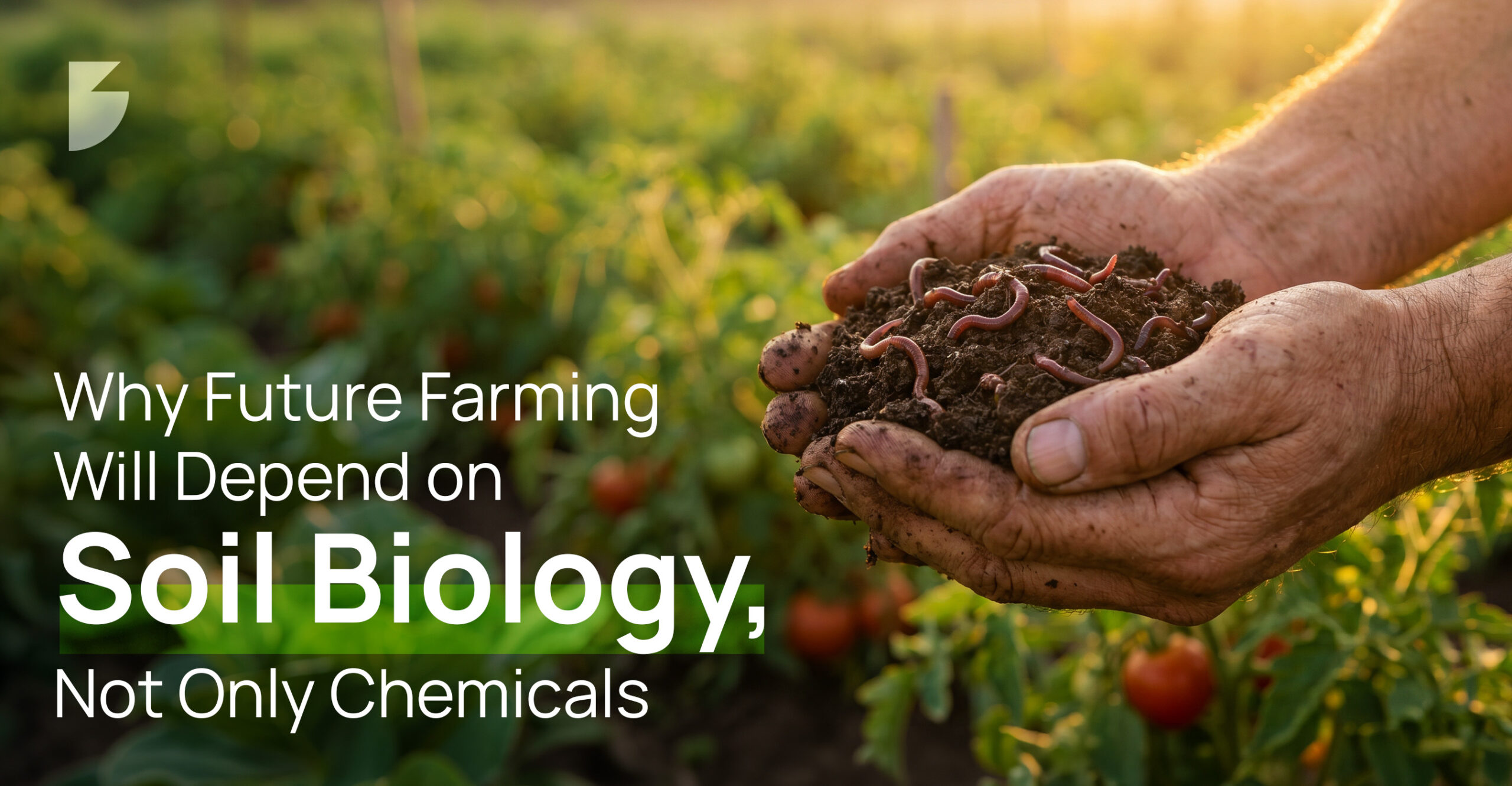
Below the surface, millions of microorganisms, fungi, bacteria, earthworms and other soil organisms are constantly working. They help break down organic matter, cycle nutrients, improve soil structure and support healthier root activity.
This invisible world is called soil biology.
Soil Biology: The System Beneath the Crop
A crop may look healthy above the ground, but its real strength begins below it.
Healthy soil biology helps create an environment where roots can grow better, nutrients can become more available and moisture can be managed more effectively.
When soil organisms are active, they support:
- Nutrient cycling
- Organic matter breakdown
- Better root-zone conditions
- Improved soil structure
- Stronger moisture retention
- Long-term soil fertility
This does not mean farmers should stop using fertilizers.
It means fertilizers should work with the soil, not against it.
Why Chemicals Alone Are Not Enough
When soil health declines, farmers often respond by increasing inputs.
More fertilizer.
More water.
More correction.
But if the soil is unable to hold moisture, support roots or make nutrients available efficiently, higher input use may not always create better results.
In fact, weak soil can lead to:
- Nutrient loss
- Poor fertilizer response
- Uneven crop growth
- Higher input costs
- More water stress
- Reduced long-term productivity
The future of farming will not depend only on how much input is applied.
It will depend on how efficiently the soil helps the crop use that input.
Soil Biology and Water Management Are Connected
Soil biology cannot be separated from water management.
Too much water can reduce air movement around roots. Too little water can slow biological activity and nutrient movement. Irregular moisture can affect the entire root-zone environment.
That is why controlled irrigation, moisture management and soil protection are becoming more important.
Practices such as drip irrigation, mulching, organic matter improvement and balanced water use can support a healthier soil environment over time.
When water reaches the right place, roots function better.
When roots function better, soil biology can support stronger crop growth.
The Future Is About Balance
Future-ready farming will not be about choosing between chemicals and natural processes.
It will be about balance.
Balanced nutrition.
Balanced moisture.
Balanced soil activity.
Balanced input use.
The strongest farms will be those that treat soil as a living asset, not just a surface to grow crops on.
At Bhumi Irrigation, we believe better farming begins with better systems.
Because when soil, water and crop needs work together, farming becomes more efficient, more resilient and more sustainable.
The future of farming is not only in what we add to the soil.
It is also in how well we help the soil stay alive.